If you’ve recently come across the term “IONK” in a text message, social media post, or chat conversation, you’re not alone in wondering what it means.
Internet slang evolves quickly, and new abbreviations pop up all the time sometimes leaving people confused or misinterpreting messages. That’s exactly why many users search for “IONK meaning in text.”
Understanding slang like IONK can help you stay updated with modern communication, avoid awkward misunderstandings, and respond appropriately in conversations.
Whether you saw it in a casual chat, on TikTok comments, or in a group message, knowing its meaning and context can make a big difference.
Definition & Meaning
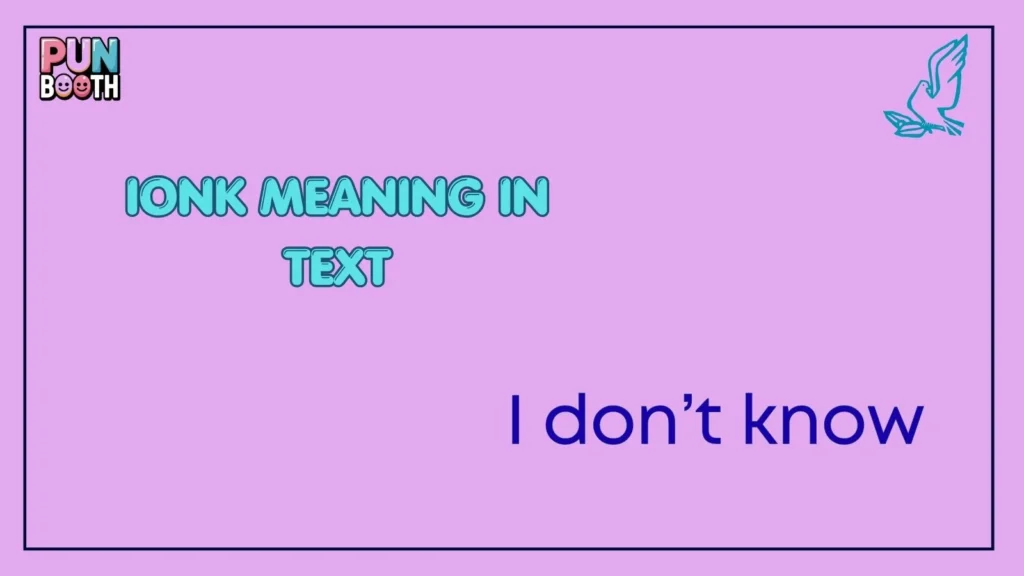
IONK is an informal slang abbreviation often used in texting and online messaging. While it’s not as widely standardized as some other acronyms, it is commonly interpreted as:
“I don’t know” (stylized or exaggerated form)
In some cases, it can also imply:
- Confusion or uncertainty
- A casual or humorous tone
- A stylized version of “IDK” (I don’t know)
The “ONK” part doesn’t have a literal standalone meaning; it’s more about how people creatively modify abbreviations to sound unique, expressive, or trendy.
Example:
- “What time is the party?”
- “IONK, maybe around 8?”
Here, it simply replaces “I don’t know” but with a more playful or stylized feel.
Background & History
IONK doesn’t have a clear, traceable origin like older internet slang such as “LOL” or “BRB.” Instead, it appears to have emerged from the culture of modifying existing abbreviations to create new variations.
As texting and social media platforms grew—especially apps like TikTok, Snapchat, and Instagram—users began experimenting with language. Acronyms like “IDK” evolved into more expressive forms such as:
- “Ion know”
- “Ion kno”
- “IONK”
The term likely comes from phonetic typing—how people pronounce “I don’t know” quickly in casual speech (“I-on-know”). Over time, this phonetic style turned into written slang.
Usage in Various Contexts
IONK is mostly used in informal settings. You’ll commonly see it in:
1. Casual Text Messages
Used between friends in everyday chats.
Example: “IONK what to wear today 😭”
2. Social Media Comments
Appears in replies or captions where users express uncertainty.
Example: “IONK why this is so funny 😂”
3. Gaming Chats
Players may use it when unsure about strategies or outcomes.
Example: “IONK if we can win this round”
4. Humor & Memes
Sometimes used to exaggerate confusion for comedic effect.
Common Misconceptions & Clarifications
There are a few misunderstandings about IONK:
- It’s not a formal acronym: Unlike “NASA” or “FBI,” IONK has no official meaning.
- It’s not offensive by default: Some may assume it has a hidden meaning, but generally, it doesn’t.
- It doesn’t always mean something new: In most cases, it’s just a variation of “I don’t know.”
However, context always matters. The tone of the conversation can slightly change how it feels.
Similar Terms & Alternatives
IONK belongs to a family of similar expressions:
- IDK – Standard and widely accepted
- Ion know – More phonetic, casual spelling
- Dunno – Informal but more traditional
- No idea – Clear and neutral
- Not sure – Slightly more polite
Each of these can replace IONK depending on how casual or formal you want to sound.
How to Respond to This Term
Responding to IONK is simple because it usually indicates uncertainty. Here are a few ways:
- Provide clarification:
“It starts at 7 PM.” - Offer help:
“I can check for you.” - Agree casually:
“Same, I’m not sure either.” - Keep the tone light:
“We’ll figure it out 😂”
Your response should match the tone—casual and relaxed.
Regional or Cultural Differences
IONK is mostly used in English-speaking online communities, especially among younger audiences. It’s more common in:
- The United States
- The UK
- Online global youth culture
In regions like South Asia, including Pakistan, it’s used mainly by people who are active on international social media platforms.
Comparison with Similar Terms
While IONK and IDK mean the same thing, the difference lies in tone:
- IDK: Neutral, widely understood
- IONK: Trendy, expressive, slightly playful
IONK feels more informal and personality-driven, while IDK is safer in most contexts.
Usage in Online Communities & Dating Apps
IONK can appear in:
- Dating apps: Showing casual uncertainty
“IONK what I’m looking for yet” - Forums & comments: Expressing confusion or humor
- Group chats: Keeping conversations relaxed
It helps maintain a laid-back tone, which is common in digital communication.
Hidden or Offensive Meanings
Generally, IONK does not have offensive meanings. However:
- Tone and context can change perception
- In rare cases, it might sound dismissive if overused
Example:
- “IONK” alone might seem uninterested or lazy in conversation
Suitability for Professional Communication
IONK is not suitable for professional or formal settings.
Avoid using it in:
- Emails
- Work chats
- Academic writing
Instead, use:
- “I’m not sure”
- “I don’t have that information”
Keeping communication clear and professional is important in formal environments.
FAQs:
What does IONK stand for in text?
It generally means “I don’t know” in a stylized, informal way.
Is IONK the same as IDK?
Yes, both mean the same, but IONK is more casual and trendy.
Is IONK rude or offensive?
No, but it can seem lazy or dismissive depending on context.
Where is IONK commonly used?
Mostly in social media, texting, and casual online conversations.
Can I use IONK in professional messages?
No, it’s best to avoid slang in formal communication.
Why do people use IONK instead of IDK?
To sound more expressive, unique, or trendy in casual chats.
Conclusion:
IONK is a modern slang term that reflects how language continues to evolve in digital communication. While it simply means “I don’t know,” its stylized form adds personality and a casual tone to conversations.
It’s widely used among younger audiences and in informal settings, especially on social media and messaging apps.
However, like many slang terms, it’s important to use it appropriately. While it works perfectly in friendly chats, it’s not suitable for professional or formal communication.
Understanding terms like IONK helps you stay connected with current trends and communicate more effectively in today’s fast-paced digital world.

Hi! I’m Ethan Walker, the creator behind PunBooth, a place where words come to life and meanings finally make sense.
I’ve always been fascinated by how language keeps evolving, especially in the digital world. From trending slang to mysterious text abbreviations, I enjoy breaking things down into simple, clear explanations that anyone can understand. That curiosity is what inspired me to create PunBooth, a space where confusion turns into clarity.