In today’s fast-paced digital world, texting shortcuts and slang have become a natural part of communication. One such commonly used abbreviation is IK.
If you’ve ever seen this term in messages, social media comments, or chats and wondered what it means, you’re not alone. Many people search for “IK meaning in text” to better understand modern online language and avoid confusion during conversations.
“IK” is simple, yet its usage can vary depending on context, tone, and relationship between the people communicating.
Whether you’re texting friends, chatting on social media, or navigating dating apps, knowing how and when to use “IK” can help you sound more natural and confident.
Definition & Meaning
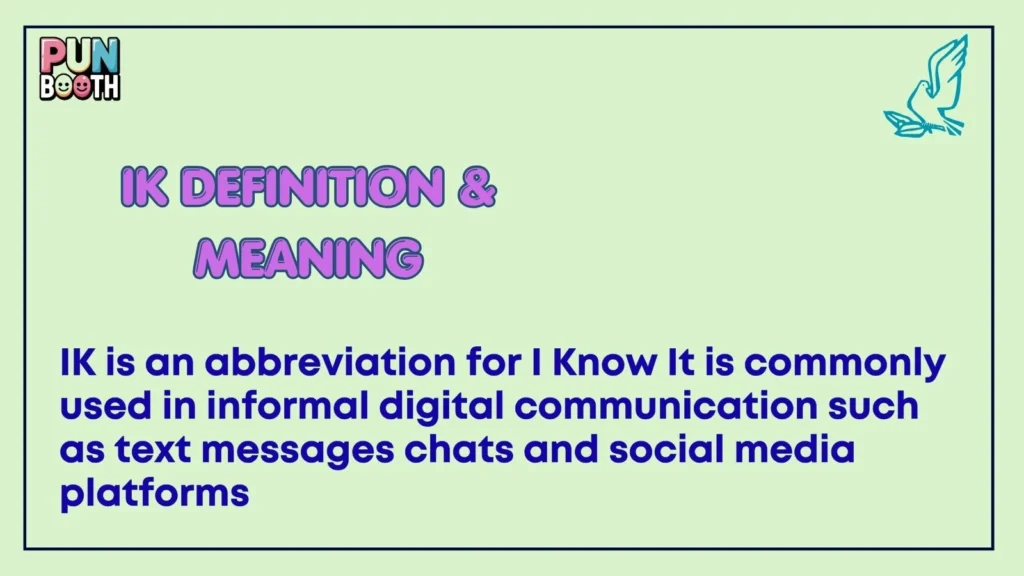
“IK” is an abbreviation for “I Know.” It is commonly used in informal digital communication such as text messages, chats, and social media platforms.
People use “IK” to express agreement, acknowledgment, or familiarity with something already mentioned. It can also show that the information being shared is obvious or already understood.
For example:
- “That movie was amazing!”
→ “IK, right?” - “This traffic is so annoying.”
→ “IK!”
In these examples, “IK” acts as a quick and casual way to confirm shared understanding. It often replaces the full phrase “I know” to save time and effort while typing.
However, tone plays an important role. Depending on how it’s used, “IK” can sound enthusiastic, sarcastic, or even slightly dismissive.
Background & History
The abbreviation “IK” emerged alongside the rise of digital communication, particularly during the early days of SMS texting and instant messaging platforms. When character limits were strict and typing on mobile devices was slower, people began shortening common phrases to communicate more efficiently.
As texting culture evolved, abbreviations like “LOL,” “BRB,” and “OMG” became widely accepted—and “IK” followed the same path. It gained popularity because of its simplicity and usefulness in everyday conversation.
With the growth of social media platforms such as messaging apps and online communities, “IK” became even more common. Today, it’s widely recognized across different age groups, though it’s especially popular among younger users who frequently use shorthand in conversations.
Usage in Various Contexts
“IK” can be used in multiple situations, depending on the tone and intent of the message.
1. Agreement
Used to show you agree with someone:
- “This song is so good.”
→ “IK!”
2. Shared Understanding
Used when both people already know something:
- “He always forgets things.”
→ “IK, it’s so annoying.”
3. Excitement
Sometimes it expresses excitement or strong emotion:
- “We’re going on vacation!”
→ “IK!! I’m so excited!”
4. Sarcasm
In certain contexts, it can sound sarcastic:
- “You should study more.”
→ “IK…” (implying annoyance)
5. Casual Conversations
Most commonly used in informal chats with friends, family, or peers.
Common Misconceptions & Clarifications
One common misconception is that “IK” always conveys a positive or friendly tone. In reality, its tone depends heavily on context and punctuation.
- Not always polite: Saying “IK” can sometimes come across as dismissive, especially if the other person is trying to explain something important.
- Not formal: It’s not suitable for professional or academic communication.
- Not always enthusiastic: Without punctuation or emojis, it may sound flat or uninterested.
Understanding these nuances helps avoid misunderstandings in conversations.
Similar Terms & Alternatives
There are several alternatives to “IK,” each with slightly different tones:
- “Yeah” / “Yep” – Casual agreement
- “Got it” – Slightly more formal acknowledgment
- “I understand” – Polite and professional
- “True” – Agreement in online slang
- “Exactly” – Strong agreement
Choosing the right alternative depends on the context and the relationship between the speakers.
How to Respond to This Term
If someone sends you “IK,” your response should depend on the situation:
- Continue the conversation:
“IK, right? It’s crazy!” - Add more detail:
“IK, but did you notice what happened next?” - Acknowledge and move on:
“IK, let’s do something about it.”
If it feels dismissive, you can politely re-engage by adding more context or asking a question.
Regional or Cultural Differences
While “IK” is widely understood in English-speaking communities, its usage can vary globally. In regions where English is a second language, people may not recognize it immediately.
In countries like Pakistan, India, or other multilingual societies, “IK” is mostly used by younger, internet-savvy individuals. It’s often mixed with local languages in casual chats.
Cultural tone also matters—some cultures prefer more polite or expressive communication, making “IK” seem too blunt in certain situations.
Comparison with Similar Terms
“IK” is often compared with similar abbreviations:
- IK vs OK:
“IK” shows knowledge or agreement, while “OK” confirms acceptance or permission. - IK vs Yeah:
“IK” implies prior knowledge; “Yeah” simply agrees. - IK vs Right:
“Right” can confirm correctness, while “IK” emphasizes awareness.
Understanding these differences helps you choose the most appropriate response in conversations.
Usage in Online Communities & Dating Apps
In online communities and dating apps, “IK” is commonly used to create a relaxed and conversational tone.
- Flirting:
“You’re funny.”
→ “IK 😏” (playful confidence) - Building connection:
“This place is amazing.”
→ “IK, I love it too!” - Casual bonding:
Helps create a sense of shared opinion or mutual understanding.
However, overusing it may make you seem uninterested or repetitive, so balance is key.
Hidden or Offensive Meanings
“IK” itself is not offensive, but its tone can sometimes be misinterpreted.
- It may sound arrogant if used repeatedly
- It can seem dismissive in serious conversations
- It might appear sarcastic depending on punctuation
Adding emojis or extra words can soften the tone and avoid misunderstandings.
Suitability for Professional Communication
“IK” is not recommended for professional settings.
In emails, workplace chats, or formal discussions, it’s better to use:
- “I understand”
- “Noted”
- “I’m aware”
Using “IK” in professional communication may come across as too casual or even slightly rude.
FAQs:
What does IK stand for in text?
It stands for “I Know,” used to show agreement or awareness.
Is IK rude in texting?
Not always, but it can sound dismissive depending on tone and context.
Can I use IK in formal communication?
No, it’s best suited for casual conversations only.
What is the difference between IK and OK?
“IK” shows knowledge, while “OK” shows acceptance or agreement.
Why do people use IK instead of I know?
It saves time and fits the fast pace of digital communication.
Does IK have different meanings?
Mostly it means “I know,” but tone can change its interpretation.
Conclusion:
IK is a simple yet powerful abbreviation that plays a big role in modern digital communication. While it primarily means “I know,” its tone and impact depend heavily on context, punctuation, and the relationship between speakers.
Understanding how to use it correctly can make your conversations smoother, more natural, and more engaging.
However, like many slang terms, it’s important to use “IK” appropriately. It works best in casual settings with friends or peers, but should be avoided in formal or professional communication.
By mastering its meaning, variations, and proper usage, you can confidently navigate online conversations without confusion or misinterpretation.

Hi! I’m Ethan Walker, the creator behind PunBooth, a place where words come to life and meanings finally make sense.
I’ve always been fascinated by how language keeps evolving, especially in the digital world. From trending slang to mysterious text abbreviations, I enjoy breaking things down into simple, clear explanations that anyone can understand. That curiosity is what inspired me to create PunBooth, a space where confusion turns into clarity.